Citicoline: CDP-Choline, Dose, Swiss Status and Safety
Citicoline (CDP-choline): difference from choline, novel food status in Switzerland and the EU, 500 mg a day maximum, research and safety.
Updated 23 November 2026 · 6 min read
In short: citicoline, also called CDP-choline, is a compound the body makes itself and which supplies two building blocks: choline and cytidine. In the European Union it has been authorised as a novel food ingredient since 2014, in food supplements, up to 500 mg a day; this authorisation also applies in Switzerland. Research studies it mostly in older adults, but in 2024 EFSA concluded that a link with memory was not established: no health claim is authorised.
What is citicoline?
Citicoline (chemical name: cytidine 5’-diphosphocholine) is a molecule naturally present in every cell. It takes part in making phosphatidylcholine, one of the main components of cell membranes.
Taken orally, it is largely split in the gut into two components, choline and cytidine, which pass into the blood. In the body, cytidine is converted into uridine. The body can then reuse these building blocks to rebuild the molecule.
Supplements use citicoline obtained by fermentation, as a white crystalline powder. The 2014 European decision sets a minimum purity of 98%. Some manufacturers sell a branded citicoline (for example Cognizin®), but the substance is the same.
Choline and citicoline: what is the difference?
The two are often confused. They are, however, distinct substances with different statuses.
| Choline | Citicoline (CDP-choline) | |
|---|---|---|
| Nature | Nutrient | Compound of choline and cytidine |
| Sources | Eggs, liver, meat, fish, pulses | Made by the body; in supplements, obtained by fermentation |
| Reference intake | 400 mg a day for adults (EFSA adequate intake, 2016) | No reference intake |
| Status in supplements | Common ingredient (bitartrate, choline chloride, etc.) | Authorised novel food, maximum 500 mg a day |
| Other close forms | Alpha-GPC, phosphatidylcholine | – |
The adequate intake of choline set by EFSA is 400 mg a day for adults, 480 mg during pregnancy and 520 mg during breastfeeding. A varied diet generally covers these needs. Citicoline is therefore not a way to “top up” your choline: it is an ingredient studied in its own right.
What is the status of citicoline in Switzerland and the EU?
A novel food authorised since 2014
A “novel food” is a food or ingredient that was little consumed in Europe before 15 May 1997. It can be sold only after a safety assessment and an authorisation.
For citicoline:
- 2013: the European Food Safety Authority (EFSA) concludes that citicoline is safe for the proposed uses and doses.
- 2014: Implementing Decision 2014/423/EU authorises its placing on the market as a novel food ingredient.
The conditions set:
| Use | Maximum dose |
|---|---|
| Food supplements | 500 mg a day |
| Foods for special medical purposes | 250 mg per serving, 1,000 mg a day |
| Foods intended for children | Use prohibited |
And in Switzerland?
According to the Federal Food Safety and Veterinary Office (FSVO), novel foods authorised by the EU may be placed on the Swiss market under the same conditions of use. A supplement sold in Switzerland may therefore contain citicoline up to 500 mg per daily serving, with a statement that it is not intended for children.
No health claim
In 2024, EFSA examined a claim application on citicoline and memory in middle-aged or older adults. Its conclusion: a cause-and-effect relationship is not established. The European Commission refused the claim in 2025. In Switzerland as in the EU, a supplement therefore cannot promise anything about citicoline.
What doses have been studied?
Doses vary widely depending on the type of study:
- Studies in healthy adults: most often 250 to 500 mg a day, in one intake, for 4 to 12 weeks.
- Clinical studies in hospital settings: doses of 1,000 mg a day and above, sometimes by injection. These uses belong to medicine, not to food supplements.
In a supplement sold in Switzerland or the EU, the daily dose cannot exceed 500 mg.
What does research say about citicoline?
| Study | Participants | What was observed |
|---|---|---|
| Nakazaki et al., 2021 (The Journal of Nutrition) | 100 healthy adults aged 50 to 85 with an age-related memory complaint, 12 weeks | With 500 mg a day: a difference on an episodic memory test compared with placebo. A single study. |
| EFSA, 2024 (claim evaluation) | Analysis of all the studies submitted | The 2021 result was not found in another study at 1 g a day for 3 months. Link with memory judged not established. |
Key takeaway: citicoline is a sound ingredient from a safety standpoint, but data in healthy adults remain scarce and do not allow conclusions. This research does not concern our product.
Is citicoline safe?
EFSA’s 2013 assessment found no safety concern at the authorised doses. Clinical reviews, which often cover higher doses, report uncommon and generally mild adverse effects: digestive upset, headache, sleep disturbance. EFSA also noted that citicoline might interact with certain medicines.
In practice:
- do not exceed the dose stated on the label;
- do not combine several products that contain it without working out the total (500 mg a day at most);
- do not give it to children.
Citicoline in Pure Focus
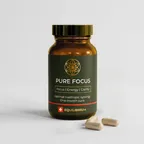
Our Pure Focus formula contains 250 mg of citicoline per daily serving of 3 capsules, half of the authorised maximum. It is combined with eight other ingredients at declared doses: Lion’s Mane (1,000 mg), L-theanine (200 mg), bacopa (200 mg), rhodiola (180 mg), ginkgo (120 mg) and vitamins B6, B9 and B12. Vitamin B6, vitamin B12 and folate contribute to the reduction of tiredness and fatigue and to normal psychological function. Pure Focus is made in Switzerland and contains no caffeine.
To place citicoline among the other ingredients, read our comparison of natural nootropics and our complete guide to nootropics.
Precautions
- Pregnancy and breastfeeding: ask your doctor for advice, data are lacking.
- Children: citicoline is not authorised in foods intended for them.
- Current treatment: talk to your doctor or pharmacist before taking it, especially if you are on neurological treatment.
- Anticoagulants and antiplatelet drugs: Pure Focus contains ginkgo, which is not recommended in this case; ask your doctor for advice.
- Unusual memory difficulties: see a doctor. A food supplement is not a treatment.
Article published on 23 November 2026 by the Swiss Equilibrium team. This article reports on the state of research and does not replace the advice of a doctor or pharmacist. Food supplements are not a substitute for a varied and balanced diet.
Frequently asked questions
What is the maximum dose of citicoline in a supplement?
In the European Union, and so in Switzerland, citicoline is authorised in food supplements up to 500 mg a day. It must not be used in foods intended for children.
Citicoline or choline: which should I choose?
They are not the same substance. Choline is a nutrient found in food; citicoline is a compound that provides choline and cytidine. To meet your choline needs, diet (eggs, meat, fish, pulses) is generally enough.
Is citicoline a medicine?
In the EU and Switzerland, citicoline can be sold as an ingredient of food supplements since 2014, up to 500 mg a day. The higher doses studied in hospital settings fall under a different framework.
When should I take citicoline?
There is no officially recommended time. Studies most often gave it as one daily intake, in the morning. Follow the dose stated on the label.
Does citicoline have side effects?
At supplement doses, it is generally well tolerated. Reported effects are uncommon: digestive upset, headache, sleep disturbance. Ask your doctor for advice if you are on treatment.
- Commission européenne (2014). Décision d'exécution 2014/423/UE autorisant la mise sur le marché de la citicoline en tant que nouvel ingrédient alimentaire. https://eur-lex.europa.eu/legal-content/DE/TXT/?uri=CELEX%3A32014D0423
- EFSA NDA Panel (2013). Scientific Opinion on the safety of citicoline as a novel food ingredient. EFSA Journal, 11(10), 3421. https://www.BFR.bund.de/cm/343/efsa-opinion-on-the-safety-of-citicoline.pdf
- EFSA NDA Panel (2024). 'Citicoline' and support of the memory function: evaluation of a health claim pursuant to Article 13(5) of Regulation (EC) No 1924/2006. EFSA Journal, 22(7), e8861. https://www.ncbi.nlm.nih.gov/pmc/articles/PMC11222871/
- Nakazaki E. et al. (2021). Citicoline and Memory Function in Healthy Older Adults: A Randomized, Double-Blind, Placebo-Controlled Clinical Trial. The Journal of Nutrition, 151(8), 2153-2160. https://pmc.ncbi.nlm.nih.gov/articles/PMC8349115/
- EFSA NDA Panel (2016). Dietary Reference Values for choline. EFSA Journal, 14(8), 4484. https://efsa.europa.eu/en/efsajournal/pub/4484
- Secades J.J. (2016). Citicoline: pharmacological and clinical review, 2016 update. Revista de Neurología, 63(S03), S1-S73. https://pubmed.ncbi.nlm.nih.gov/28417449/
- OSAV (BLV). Autorisation pour les nouvelles sortes de denrées alimentaires. https://www.blv.admin.ch/fr/autorisation-nouvelles-sortes-denrees-alimentaires