L-theanine: effects, dosage, sleep and side effects
Share
In short: L-theanine is an amino acid found naturally in tea leaves (Camellia sinensis). It is what gives tea its "calm but alert" effect. Studies have mainly observed two things: combined with caffeine, it improves some attention tests in the short term; taken alone for a few weeks (200 mg per day), it has been linked to fewer stress-related symptoms and better perceived sleep. Trials remain small. The usual dose is 100 to 200 mg. It is well tolerated, not sedating and not habit-forming.
What is L-theanine?
L-theanine is an amino acid that is not used to build proteins. It is found almost only in tea (green, black, oolong) and in one mushroom, the bay bolete. A cup of tea contains about 8 to 30 mg, depending on the variety and brewing time. Food supplements usually provide 100 to 200 mg per dose.
It crosses the blood-brain barrier, where it is studied for its influence on certain chemical messengers (GABA, glutamate) and on the brain's electrical activity, in particular alpha waves, associated with relaxed alertness.
What do studies say about L-theanine?
| Study | Participants | What was observed |
|---|---|---|
| Haskell et al., 2008 (Biological Psychology) | 27 healthy adults | The combination of L-theanine (250 mg) and caffeine (150 mg) improved speed and accuracy on some attention tests, better than either substance alone on several measures. |
| Hidese et al., 2019 (Nutrients) | 30 healthy adults, 4 weeks | 200 mg per day: lower stress-related symptom scores and better perceived sleep quality than placebo. Some effects on verbal fluency. |
Key takeaway: the best-documented effect is the combination with caffeine on short-term attention. Effects on stress and sleep are promising but rest on few studies. No health claim is authorised for L-theanine in Switzerland or the European Union.
L-theanine and caffeine: the most studied pair
Caffeine increases alertness but can make you jittery. L-theanine seems to soften this effect. That is why many people combine the two, for example 100 to 200 mg of L-theanine with a coffee. Studies generally use a ratio of about 1:1 to 2:1 (L-theanine to caffeine).
L-theanine and sleep
L-theanine is not a sleeping pill: it does not make you sleep. But by reducing feelings of tension, it may help you recover better. In the 2019 study, participants reported better sleep quality after 4 weeks at 200 mg per day. If you have persistent sleep problems, talk to your doctor.
How much L-theanine?
- Usual dose: 100 to 200 mg in one dose, up to 400 mg per day in some studies.
- Timing: in the morning or during the day with a coffee for focus, or in the evening to unwind.
- Onset: an effect felt about 30 to 60 minutes after intake is often described.
Is L-theanine safe?
At usual doses, L-theanine is well tolerated in studies. Side effects are rare: headaches, mild drowsiness. As a precaution:
- ask your doctor during pregnancy and breastfeeding;
- talk to your doctor if you take blood pressure medication or a sedative;
- do not exceed the dose stated on the label.
L-theanine in Pure Focus
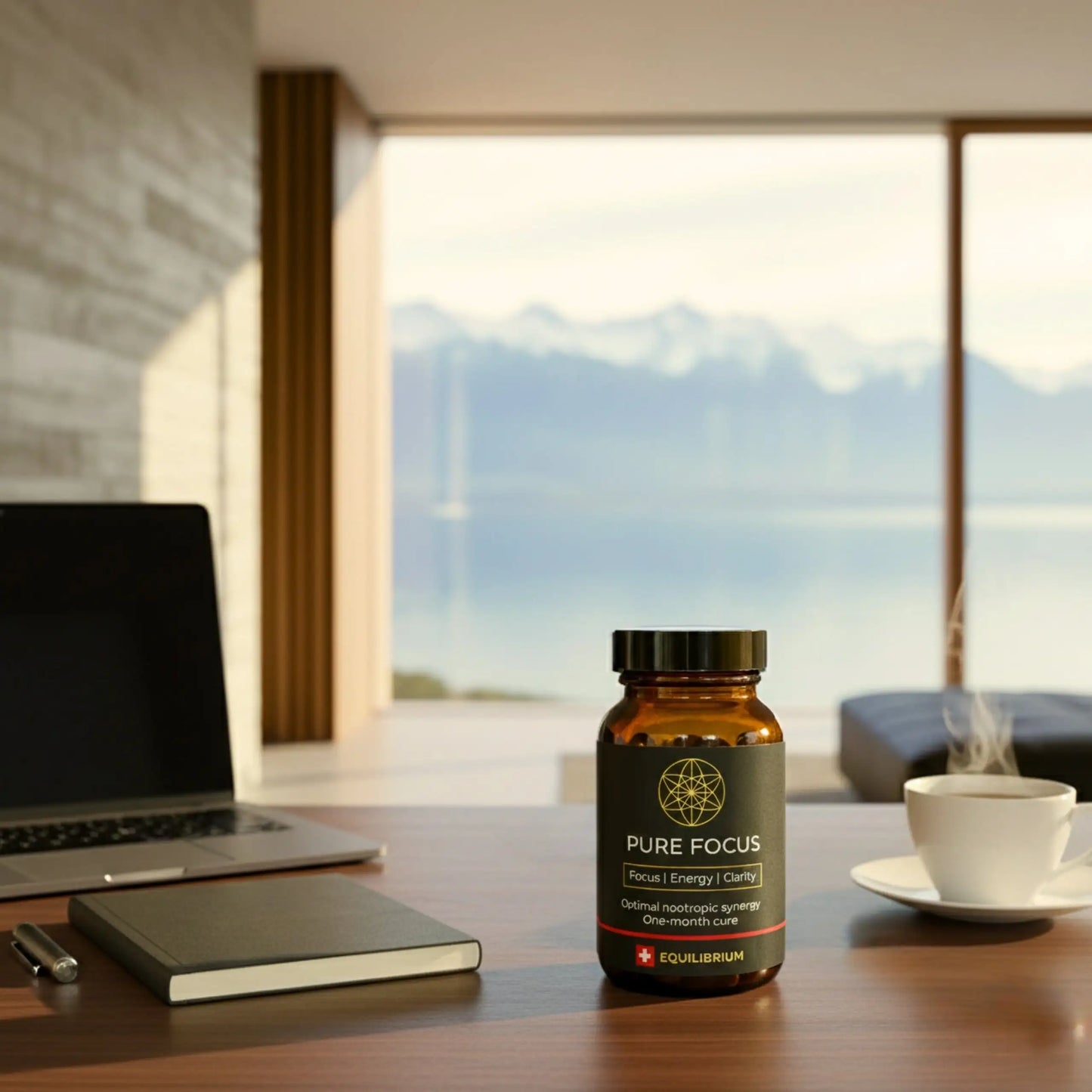
Our Pure Focus formula contains 200 mg of L-theanine per daily dose, with eight other ingredients including 1,000 mg of Lion's Mane, citicoline, bacopa and rhodiola. It contains no caffeine, so you can take it with your morning coffee. The vitamins B6, B9 and B12 it contains contribute to normal psychological function and to the reduction of tiredness and fatigue.
To understand the other ingredients, read our guide to nootropics and our Lion's Mane guide.
Frequently asked questions about L-theanine
Is L-theanine dangerous?
At the doses studied (100 to 400 mg per day), it is well tolerated. Reported side effects are rare: headaches, mild drowsiness.
How much L-theanine should I take?
Most studies use 100 to 200 mg in one dose, sometimes up to 400 mg per day. Follow the dose on the label.
Does L-theanine make you sleepy?
No, it is not sedating at usual doses. One study observed better perceived sleep quality, but it is not a sleeping pill.
How much L-theanine is in a cup of tea?
About 8 to 30 mg depending on the tea and brewing, far less than the doses used in studies.
Can you take L-theanine with coffee?
Yes. It is actually the most studied combination.
Sources
- Haskell C.F. et al. (2008). The effects of L-theanine, caffeine and their combination on cognition and mood. Biological Psychology, 77(2), 113-122. PubMed
- Hidese S. et al. (2019). Effects of L-Theanine Administration on Stress-Related Symptoms and Cognitive Functions in Healthy Adults: A Randomized Controlled Trial. Nutrients, 11(10), 2362. PMC
Published on 10 October 2026 by the Swiss Equilibrium team. This article reports on the state of research and does not replace advice from a doctor or pharmacist. Food supplements should not replace a varied and balanced diet.