French Mush vs Swiss Equilibrium: Which Lion's Mane to Choose?
Lion's mane French Mush or Swiss Equilibrium? A factual comparison of declared features: part used, standardisation, daily content, capsules, origin and testing.
Updated 23 November 2026 · 7 min read
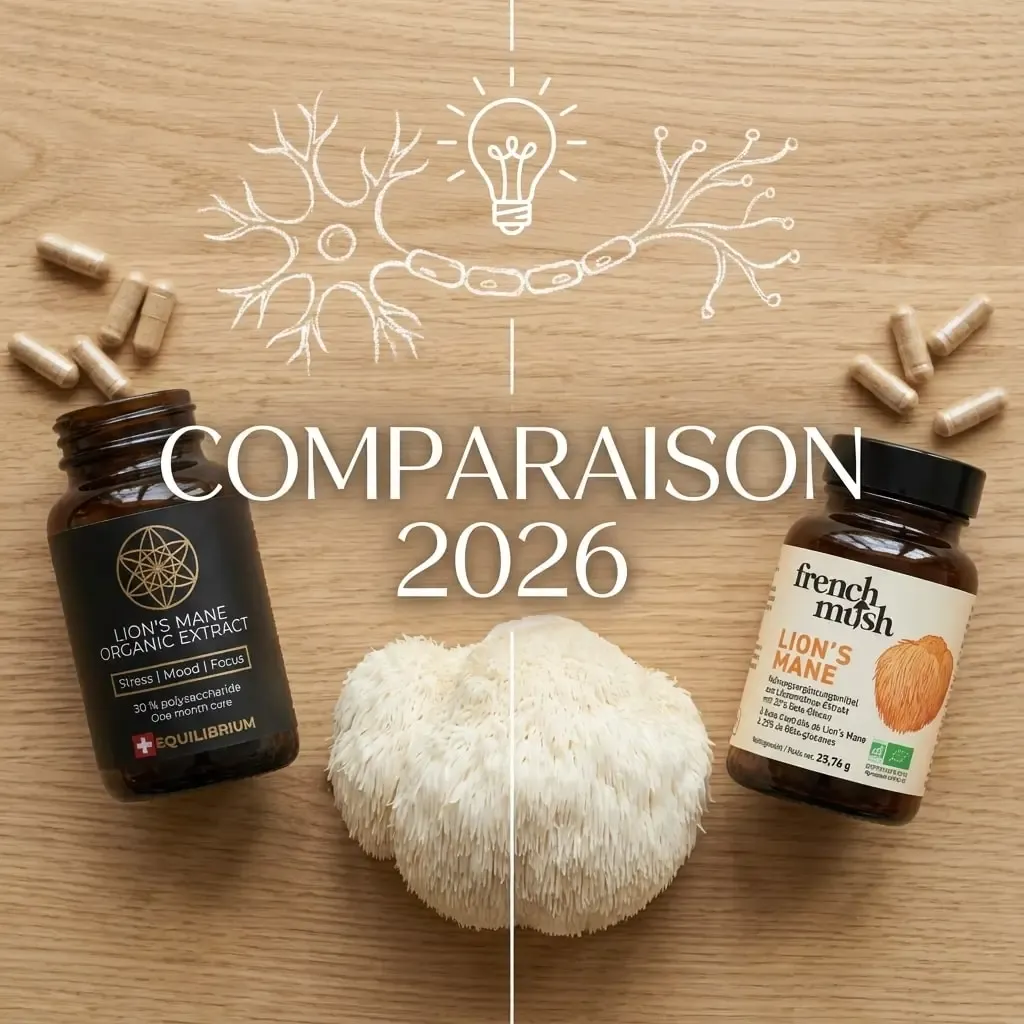
A factual comparison to choose a lion’s mane supplement with full information
Introduction: lion’s mane, a mushroom on the rise
Lion’s mane (Hericium erinaceus) has become one of the most popular mushrooms in food supplements. With its growing popularity in France and Switzerland, many brands now offer extracts, with technical sheets that are sometimes hard to compare.
In this article, we put two products side by side: French Mush lion’s mane and Swiss Equilibrium lion’s mane. Our aim? To present the features declared by each brand, neutrally, to help you choose.
Transparency: this article is written by Swiss Equilibrium. Information on French Mush comes from its public information at the time of writing and may have changed. Check it on the brand’s website.
What is lion’s mane (Hericium erinaceus)?
Lion’s mane is an edible mushroom, eaten for a long time in cooking and in Asian tradition. It now attracts the interest of researchers:
- Preliminary studies, mostly in vitro and in animals, look at some of its compounds (hericenones, erinacines) and at NGF (Nerve Growth Factor)
- A few small human studies exist, but they remain limited
- There is no authorised health claim for lion’s mane
Extracts are generally standardised on one family of compounds: polysaccharides or beta-glucans, depending on the brand.
French Mush lion’s mane: declared features
Composition and dose
According to the information published by the brand:
Ingredients:
- Organic lion’s mane extract (Hericium erinaceus)
- 100% fruiting body of European origin
- 400 mg per capsule (2 capsules = 800 mg per dose)
Declared standardisation:
- 24.4% beta-glucans
- 0.9% hericenones
- 2.1% adenosine
- 0.4% ergosterol
Capsules: vegan, made of plant cellulose
Key points
- Mushroom of European origin
- Detailed analysis sheet, with several compounds stated (including hericenones)
- Declared daily dose: 800 mg of extract
Swiss Equilibrium lion’s mane: declared features
Composition and dose
Ingredients:
- 100% fruiting body of Hericium erinaceus, no mycelium
- Organic farming
- Extraction ratio 1:15
- 1,000 mg of extract per daily dose (2 capsules)
Declared standardisation:
- 30% polysaccharides, measured on the certificate of analysis of each batch
Capsules: vegetable capsules made of hydroxypropyl methylcellulose (HPMC)
Key points
- Made in Switzerland
- Tested for heavy metals
- Vegan, gluten-free, GMO-free
- Jar of 60 capsules for exactly 30 days
Direct comparison: summary table
| Criterion | Swiss Equilibrium | French Mush |
|---|---|---|
| Part used | 100% fruiting body | 100% fruiting body |
| Extract per daily dose | 1,000 mg | 800 mg |
| Declared standardisation | 30% polysaccharides | 24.4% beta-glucans |
| Other declared compounds | Not stated | Hericenones, adenosine, ergosterol |
| Farming | Organic | Organic |
| Origin / manufacture | Made in Switzerland | Mushroom of European origin |
| Capsule type | Vegetable HPMC | Plant cellulose |
Polysaccharides and beta-glucans: figures that cannot be compared directly
It is tempting to multiply the dose by the percentage to compare two products. That is a mistake:
- Polysaccharides are a large family of complex carbohydrates
- Beta-glucans are only a sub-family
- The analysis methods used by laboratories are not the same and give different results
A product at “30% polysaccharides” and a product at “24.4% beta-glucans” therefore do not measure the same thing. These figures do not show which contains more compounds of interest, and still less which would be the more effective.
What matters most is that the brand clearly states what it measures and can provide a certificate of analysis for each batch.
Organic lion’s mane: why origin and controls matter
French Mush and Swiss Equilibrium both rely on mushrooms from organic farming. Whichever brand you choose, here is what you can check:
- The organic certificate
- Contaminant analyses (heavy metals, pesticides)
- The part of the mushroom used (fruiting body or mycelium)
- Traceability from the mushroom to the finished product
Which one to choose?
Both products are organic fruiting body extracts. The choice depends on your criteria:
Swiss Equilibrium lion’s mane
- You want a product made in Switzerland
- You prefer a daily dose of 1,000 mg of extract
- You want a jar that lasts exactly one month, with a subscription you can cancel at any time
French Mush lion’s mane
- You favour a mushroom of European origin
- You want an analysis sheet stating several compounds, including hericenones
How to choose your lion’s mane supplement
Ask yourself these questions, whatever the product:
1. Which part of the mushroom is used?
Answer: fruiting body, mycelium, or both? Both products compared here use only the fruiting body.
2. Is the standardisation clearly declared?
Answer: check what is measured (polysaccharides, beta-glucans, etc.) and ask for the certificate of analysis.
3. Is the origin transparent?
Answer: both brands state organic cultivation. Swiss Equilibrium is made in Switzerland.
4. What is the daily dose?
Answer: 1,000 mg of extract a day at Swiss Equilibrium, 800 mg at French Mush.
5. Is the product made and tested in Switzerland?
Answer: Swiss Equilibrium is made in Switzerland and tested for heavy metals.
Conclusion
Swiss Equilibrium and French Mush both offer lion’s mane extracts made from the fruiting body and from organic farming. They differ in daily dose, standardisation method (polysaccharides on one side, beta-glucans on the other, two measurements not directly comparable) and origin. Swiss Equilibrium is the only one of the two made in Switzerland, with 1,000 mg of extract a day.
If you are looking for an extract that is organic, made in Switzerland, standardised to 30% polysaccharides and tested for heavy metals, discover Swiss Equilibrium lion’s mane.
Article written by Swiss Equilibrium. Information on French Mush is based on the brand’s public data at the time of writing.
Warning: food supplements do not replace a varied, balanced diet or a healthy lifestyle. Ask a healthcare professional before any supplementation, particularly if you are pregnant, breastfeeding or on medication.
Frequently asked questions
Can I directly compare 30% polysaccharides and 24.4% beta-glucans?
No. Polysaccharides and beta-glucans are not the same measurement: beta-glucans are a sub-family of polysaccharides, and analysis methods differ. These figures therefore do not show that one product contains "more actives" than the other.
Where can I buy Swiss Equilibrium lion's mane?
Swiss Equilibrium lion's mane is available in our online shop, with delivery in Switzerland and France.
What is the difference between extract and powder?
Powder is the dried, ground mushroom. An extract is obtained by extraction (for example in hot water), which concentrates certain compounds and allows the product to be standardised. Both products compared here are extracts.
How long before I can expect effects?
There is no authorised health claim for lion's mane, so we promise no effect and no timeframe. Respect the stated daily dose and include the supplement in a varied, balanced diet.
Are there side effects?
Lion's mane is generally well tolerated. Rare, mild side effects are possible (slight digestive upset at the start). Ask a healthcare professional if in doubt.
Can I combine it with other supplements?
It is possible, but check the combined doses (Pure Focus, for example, already contains 1,000 mg of lion's mane) and ask a healthcare professional for advice if you take medication.
- Mori K. et al. (2009). "Improving effects of the mushroom Yamabushitake (Hericium erinaceus) on mild cognitive impairment." Phytotherapy Research.
- Vigna L. et al. (2019). "Hericium erinaceus Improves Mood and Sleep Disorders." Evidence-Based Complementary Medicine.