Lion's Mane Capsules or Powder: Which to Choose?
Raw powder, extract or lion's mane capsules: what changes for the dose, the taste and the price per day. What a 1:15 extract means.
Updated 22 November 2026 · 5 min read
In short: lion’s mane powder is dried, ground mushroom: it is cheaper per gram, but unconcentrated, and you need several grams a day. An extract is obtained by hot-water extraction (sometimes followed by alcohol extraction) and then dried: it is more concentrated and can be standardised, meaning its polysaccharide or beta-glucan content is measured. Capsules are a format, not a quality: they can contain powder or extract. The right calculation is not the price per gram, but the price of the daily dose stated by the manufacturer.
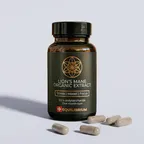
A figure for reference: in a 1:15 extract, about 15 kg of dried mushroom was used to produce 1 kg of extract. Our organic lion’s mane is a 1:15 fruiting body extract, at 2 capsules (1,000 mg) a day.
Three forms, three different products
| Raw powder | Powdered extract | Extract in capsules | |
|---|---|---|---|
| What it is | Dried, ground mushroom | Extracted mushroom, then dried | Extract dosed into vegetable capsules |
| Concentration | None | Depends on the ratio (1:10, 1:15…) | Depends on the ratio |
| Declared standardisation | Rarely | Often | Often |
| Usual daily amount | Several grams | About 0.5 to 1 g | 1 to 3 capsules |
| Taste | Earthy, pronounced | Earthy, bitter | None |
| Dosing | By the spoonful | With a measuring scoop | Fixed |
| Price per gram | Lowest | Higher | Highest |
In published clinical trials, the products tested vary widely: powder tablets, fortified biscuits, capsules. Doses range from 1.8 to 3 g a day depending on the study and cannot be transferred from one product to another. We cover them in Lion’s mane: dosage and daily dose.
What an extraction ratio means
The extraction ratio tells you how much raw material was used to obtain a given quantity of extract:
- 1:10: 10 kg of dried mushroom for 1 kg of extract;
- 1:15: 15 kg for 1 kg;
- 1:20: 20 kg for 1 kg.
This figure describes the process. It does not tell you what is in the final extract: hot-water extraction mainly concentrates water-soluble compounds, such as polysaccharides, and leaves others behind. That is why you cannot claim that one gram of 1:15 extract is “worth” fifteen grams of powder.
The standardisation is more informative: a percentage of polysaccharides or beta-glucans measured per batch, ideally on a certificate of analysis. A product that shows a high ratio without a standardisation does not let you check much. The part of the mushroom matters too: see fruiting body or mycelium.
Powder: who is it for?
Raw powder suits you if you:
- cook with it (soups, sauces, coffee) and enjoy the earthy taste;
- want the lowest price per gram;
- accept a less precise dose, by the spoonful.
Limitations: you need to take a larger amount, the composition varies from batch to batch and most powders are not standardised.
Extract in capsules: who is it for?
Extract capsules suit you if you:
- want an identical dose every day, with no scales or spoon;
- do not like the taste of mushrooms;
- want a standardised product, comparable from batch to batch;
- take it at the office or when travelling.
Limitations: the price per gram is higher, and the vegetable capsule (HPMC or pullulan) adds to the ingredient list. If you prefer powder, an extract capsule can be opened and mixed into a drink.
Compare the price per day, not the price per gram
The most common pitfall is comparing a 100 g bag of powder with a jar of 60 capsules on price per gram. The two products do not contain the same thing. The method that works:
- Note the daily dose stated by each manufacturer.
- Divide the price by the number of days the pack lasts at that dose.
- Compare that price per day for a comparable part, form and standardisation.
For our extract, the calculation is straightforward: a jar of 60 capsules lasts exactly 30 days at 2 capsules a day, i.e. 1,000 mg of 1:15 fruiting body extract per day. Lion’s mane is also part of Pure Focus, at 1,000 mg per daily dose: there is no need to combine the two without professional advice.
Our choice
We sell lion’s mane only as an extract in capsules: organic fruiting body, 1:15 ratio, standardised to 30% polysaccharides, tested for heavy metals, made in Switzerland. It is the format that lets us state a verifiable dose and standardisation. To find out where to buy it and how to compare the offers available in Switzerland, see Where to buy lion’s mane in Switzerland.
There is no authorised health claim for lion’s mane: the choice between powder and capsules is a matter of convenience, transparency and budget, not of effect.
Article written by the Swiss Equilibrium team. Do not exceed the recommended daily dose. Food supplements are not a substitute for a varied and balanced diet and a healthy lifestyle.
Frequently asked questions
Lion's mane capsules or powder: which should I choose?
Raw powder is cheaper per gram, but it is unconcentrated dried mushroom. An extract in capsules provides a fixed dose and a declared standardisation, with no taste. To compare, work out the price of the daily dose stated by each manufacturer, not the price per gram.
What does a 1:15 lion's mane extract mean?
That about 15 kg of dried mushroom was used to produce 1 kg of extract. This ratio describes the process, not the final content: a standardisation (polysaccharides or beta-glucans) tells you more about what the extract contains.
Is 1 g of 1:15 extract equivalent to 15 g of mushroom?
In terms of raw material used, yes. But extraction does not keep all compounds in the same proportions, so you cannot say that 1 g of extract is "worth" exactly 15 g of powder.
Can I put lion's mane powder in coffee?
Yes. Powder and powdered extract mix into coffee, a smoothie or yoghurt. The taste is earthy and slightly bitter. You can also open a capsule.
How many lion's mane capsules a day?
It depends on the content of each capsule. Our extract is taken at 2 capsules a day, i.e. 1,000 mg of 1:15 fruiting body extract, and a jar of 60 capsules lasts exactly 30 days.
- Federal Food Safety and Veterinary Office (FSVO). Food supplements. https://www.blv.admin.ch/fr/nahrungsergaenzungsmittel
- FDHA Ordinance on Food Supplements (VNem / OCAl), SR 817.022.14. Fedlex, Classified Compilation of Federal Legislation.
- Friedman M. (2015). Chemistry, Nutrition, and Health-Promoting Properties of Hericium erinaceus (Lion's Mane) Mushroom Fruiting Bodies and Mycelia and Their Bioactive Compounds. Journal of Agricultural and Food Chemistry, 63(32), 7108-7123. https://pubs.acs.org/doi/10.1021/acs.jafc.5b02914