Lion's Mane: Fruiting Body or Mycelium, What Is the Difference?
Lion's mane fruiting body or mycelium: what each part contains, the question of grain starch, and how to read a label.
Updated 22 November 2026 · 6 min read
In short: the fruiting body is the visible part of lion’s mane (Hericium erinaceus), the part you cook. The mycelium is the network of filaments that feeds it. In industrial cultivation, mycelium is often grown on rice or oat grains, and the product sold then contains a share of cereal starch. The two parts do not have the same composition: hericenones are mainly described in the fruiting body, erinacines mainly in the mycelium. Neither has an authorised health claim in Switzerland. To compare two products, you need to know three things: the part used, the substrate and the declared standardisation.
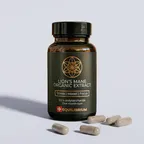
Our organic lion’s mane is a 100% fruiting body extract, 1:15 ratio, standardised to 30% polysaccharides, with no mycelium or grain substrate.
Two parts of the same mushroom
A mushroom is more than what you see. The visible part, the fruiting body, is the reproductive organ: it is what carries the spores. In lion’s mane, it forms a white mass with long spines, hence its names lion’s mane and bearded tooth mushroom.
The mycelium is the vegetative part. This network of very fine filaments (hyphae) colonises dead wood in nature, or a growing substrate in production. It exists before the fruiting body, and it is what produces it.
| Fruiting body | Mycelium | |
|---|---|---|
| What it is | The visible part, the one you cook | A network of filaments that colonises the substrate |
| Usual cultivation | On hardwood logs or sawdust, harvested then dried | On grains (rice, oats) or in liquid tanks |
| Compounds mainly described | Hericenones, polysaccharides including beta-glucans | Erinacines |
| Point to watch | Lower cultivation yield | Possible presence of substrate starch |
| Wording to look for on the label | “fruiting body” | “mycelium”, “mycelium on grain”, “biomass” |
Hericenones and erinacines: what we know
The two most frequently cited families of molecules in lion’s mane are not found in the same place. A literature review published in 2015 in the Journal of Agricultural and Food Chemistry (Friedman) describes hericenones mainly in the fruiting body and erinacines mainly in the mycelium.
These compounds are studied in the laboratory and in animals. Human data remain scarce and preliminary, and they do not concern any particular commercial product. There is no authorised health claim for lion’s mane, whether for the fruiting body or the mycelium. A product that promises an effect on memory or focus thanks to either part falls outside the Swiss legal framework.
Some manufacturers offer mycelium “enriched with erinacines”, grown in liquid tanks and then separated from its medium. This is a different product from mycelium sold with its grain: a stated erinacine content makes it possible to tell them apart.
Mycelium on grain: the starch question
In industrial production, the simplest way to grow mycelium is to inoculate it onto cooked cereal grains. After a few weeks, the mycelium has colonised the grain, but the two cannot be separated. The dried, ground product therefore contains the mycelium and what remains of the grain, largely starch.
A methods paper published in 2016 in the Journal of AOAC International (McCleary and Draga, authors linked to the analysis kit manufacturer Megazyme) describes how to measure beta-glucans and alpha-glucans, the family that starch belongs to, separately. This kind of analysis makes it possible to check whether a product made from mycelium on grain contains mostly mushroom or mostly grain, and it popularised the idea of looking at the standardisation rather than the product name.
This is not a safety issue: rice or oat starch is a food. It is a question of actual mushroom content: one gram of mycelium-on-grain powder does not contain one gram of mushroom.
Polysaccharides or beta-glucans: reading the standardisation
Product pages show a content of polysaccharides or beta-glucans. The two figures cannot be compared directly:
- polysaccharides are a large family of complex carbohydrates, which includes beta-glucans, but also starch;
- beta-glucans are a sub-family, measured by an enzymatic method that distinguishes them from starch;
- laboratories do not all use the same method, which changes the result.
A polysaccharide figure is therefore most meaningful combined with information on the part used. In a 100% fruiting body extract, with no grain substrate, there is no grain starch in the product. We go into the comparison between these two measurements in French Mush vs Swiss Equilibrium.
How to read a lion’s mane label
Four questions are enough to classify a product:
- Which part? Fruiting body, mycelium or a blend. If nothing is stated, ask the manufacturer.
- Which substrate? For mycelium: on grain, or grown in a tank and separated from its medium?
- Which standardisation? Polysaccharides, beta-glucans, sometimes hericenones or erinacines, with a percentage.
- Powder or extract? A 1:15 extract means that about 15 kg of dried mushroom was used to produce 1 kg of extract. See Lion’s mane: capsules or powder.
Add two criteria that apply to any supplement: organic certification and contaminant testing (heavy metals). Our complete lion’s mane guide covers the full checklist.
Why we chose the fruiting body
Our lion’s mane uses only the fruiting body, for the sake of transparency: with no grain substrate, the stated standardisation (30% polysaccharides) describes the mushroom, not the grain it grew on. The rest of the specification:
- organic extract, 1:15 ratio;
- 2 capsules a day, i.e. 1,000 mg of extract;
- 60 capsules, i.e. exactly 30 days;
- made in Switzerland, vegan, tested for heavy metals.
Choosing mycelium enriched with erinacines is also defensible, provided the standardisation proves it. What you should avoid is a product that does not say what it contains.
Article written by the Swiss Equilibrium team. It provides information on product composition and is not a substitute for advice from a doctor or pharmacist. Food supplements are not a substitute for a varied and balanced diet and a healthy lifestyle.
Frequently asked questions
What is the difference between lion's mane fruiting body and mycelium?
The fruiting body is the visible part of the mushroom, the part you cook. The mycelium is the network of filaments that feeds it, often grown on grain in industrial production. The two do not contain the same compounds: hericenones are mainly described in the fruiting body, erinacines mainly in the mycelium.
Is lion's mane mycelium poor quality?
Not in itself. The point to check is the substrate: mycelium grown on grain and sold with that grain contains a share of cereal starch. A transparent label states the part used, the substrate and a standardisation.
How can I tell if a product contains mycelium?
Read the ingredient list: "mycelium", "mycelium on grain", "biomass" or "full spectrum" indicate the presence of mycelium. If the part used is not stated, ask the manufacturer.
Why does the beta-glucan or polysaccharide content matter?
It tells you what you are buying and lets you check a batch. Starch is also a polysaccharide, so a high "polysaccharide" figure on a product made from mycelium on grain may include starch. A specific beta-glucan assay distinguishes them from starch.
Which part does Swiss Equilibrium lion's mane use?
Only the fruiting body, with no mycelium or grain substrate: an organic 1:15 extract, standardised to 30% polysaccharides, 2 capsules a day, made in Switzerland.
- Friedman M. (2015). Chemistry, Nutrition, and Health-Promoting Properties of Hericium erinaceus (Lion's Mane) Mushroom Fruiting Bodies and Mycelia and Their Bioactive Compounds. Journal of Agricultural and Food Chemistry, 63(32), 7108-7123. https://pubs.acs.org/doi/10.1021/acs.jafc.5b02914
- Li I-C. et al. (2018). Neurohealth Properties of Hericium erinaceus Mycelia Enriched with Erinacines. Behavioural Neurology, 5802634. https://pmc.ncbi.nlm.nih.gov/articles/PMC5987239/
- McCleary B. V., Draga A. (2016). Measurement of β-Glucan in Mushrooms and Mycelial Products. Journal of AOAC International, 99(2), 364-373. https://pubmed.ncbi.nlm.nih.gov/26957216/