Focus Without Caffeine: Coffee Alternatives and L-Theanine
Focus without caffeine: EFSA limits (400 mg a day), caffeine in common drinks, timing, tolerance, coffee and L-theanine, and non-stimulant options.
Updated 23 November 2026 · 5 min read
In short: caffeine remains the most widely used stimulant for getting through a working day. For a healthy adult, the European Food Safety Authority (EFSA) considers that up to 400 mg a day, and up to 200 mg in a single intake, raises no safety concern (200 mg a day during pregnancy). Cutting back or stopping caffeine is possible, provided you manage withdrawal and rely on other levers: sleep, light, movement, how work is organised.
How much caffeine is in your drinks?
The values below are averages published by EFSA and EUFIC. The actual content varies with the beans, the leaves, the preparation and the size of the cup.
| Drink | Serving | Caffeine (approx.) |
|---|---|---|
| Espresso | 60 ml | 80 mg |
| Filter coffee | 200 ml | 90 mg |
| Decaf coffee | 200 ml | 4 mg |
| Black tea | 220 ml | 50 mg |
| Green tea | 250 ml | 38 mg |
| Maté | One cup | Highly variable with the amount of leaf and the preparation, from a few tens of mg to over 80 mg |
| Cola | 355 ml | 40 mg |
| Energy drink | 250 ml | 80 mg |
| Dark chocolate | 50 g | 25 mg |
Two espressos in the morning, a coffee after lunch and a tea in the afternoon already add up to about 300 mg. A can of energy drink or a double espresso late in the day is enough to tip a reasonable day into poorer sleep.
When does caffeine become counterproductive?
Timing
EFSA notes that a single 100 mg dose taken close to bedtime can change the length and quality of sleep in some adults. Yet it is sleep that supports attention the next day. The classic pattern is familiar: late coffee, shorter night, tiredness the next day, more coffee. Keeping caffeine for the morning and early afternoon is a simple rule to break the cycle.
Tolerance
In regular drinkers, the body gets used to caffeine. The felt effect fades, and stopping abruptly can cause headaches, tiredness and irritability for a few days. If you want to cut back, reducing gradually over one to two weeks is generally better tolerated: replace one cup with a decaf, then a second.
Individual sensitivity
Some people become jittery, get palpitations or digestive upset from a single cup. Others drink an espresso in the evening and sleep well. Sensitivity varies a great deal from person to person: trust your own signals rather than an average figure.
Coffee and L-theanine: what does research say?
L-theanine is an amino acid found in tea. Its combination with caffeine is what has been studied most. In a study published in 2008 in 27 adults, the combination of 250 mg of L-theanine and 150 mg of caffeine was associated with differences on some attention tests, compared with placebo (Haskell et al., 2008). This is a small study looking at short-term effects.
Tea naturally contains both, but in small amounts: about 8 to 30 mg of L-theanine per cup, far from the doses used in studies. No health claim is authorised for L-theanine in Switzerland. We cover it in full in our article L-theanine: effects, dosage, sleep and safety.
How can I stay focused without caffeine?
The following options are not stimulants. They work on what weighs most on attention in everyday life.
- Protect your sleep. Regular hours, a cool bedroom, fewer screens in the evening. This is the most important lever, and the one that late caffeine damages.
- Get out into daylight in the morning. A few minutes outside early in the day help set the sleep-wake rhythm.
- Move. A 10 minute walk after lunch is a concrete alternative to the 2 pm coffee.
- Drink water. Part of the afternoon “dip” is sometimes simply linked to a lack of hydration.
- Break up the work. Blocks of 25 to 50 minutes on a single task, followed by a break away from screens.
- Choose lighter drinks. Green tea, herbal teas, decaf, sparkling water: the break ritual stays, the caffeine dose falls.
To go further, see Improve your focus naturally: 7 levers, and if tiredness dominates, Mental fatigue: causes and natural solutions. If you have a persistent “cotton wool” feeling, also read our article on brain fog.
Does Pure Focus contain caffeine?
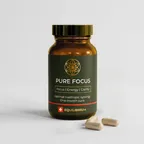
No. Pure Focus contains no caffeine. The formula combines 9 ingredients with their dose shown, including 200 mg of L-theanine, 1,000 mg of Lion’s Mane, citicoline and vitamins B6, B9 and B12. These vitamins contribute to the reduction of tiredness and fatigue. You can take it in the morning with or without coffee, depending on your habits.
Precautions
- Pregnancy and breastfeeding: EFSA sets the limit at 200 mg of caffeine a day during pregnancy. Ask your doctor or midwife for advice, including before taking a supplement.
- Children and teenagers: energy drinks are not intended for them.
- Heart problems, high blood pressure, sleep or anxiety disorders: talk to your doctor about your caffeine consumption.
- Medicines: some treatments change how the body eliminates caffeine. If in doubt, ask your pharmacist.
Article published on 23 November 2026 by the Swiss Equilibrium team. This article is for information and does not replace the advice of a doctor or pharmacist. Food supplements are not a substitute for a varied and balanced diet.
Frequently asked questions
What is the best alternative to coffee for staying focused?
There is no stimulant-free equivalent. The simplest options are a short walk, daylight, water and a real block of work without interruptions.
How many coffees a day is the maximum?
For a healthy adult, EFSA considers that up to 400 mg of caffeine a day, spread through the day, raises no safety concern, which is about 4 to 5 cups of filter coffee. During pregnancy, the limit is 200 mg a day.
What time should I stop drinking coffee to sleep well?
According to EFSA, 100 mg of caffeine taken close to bedtime can already disturb sleep in some adults. Many people stop in the early afternoon.
Does green tea contain less caffeine than coffee?
Generally yes: about 38 mg per 250 ml, against about 90 mg for a 200 ml cup of filter coffee. The content varies with the tea and the brewing.
Does decaf coffee still contain caffeine?
A little: about 4 mg for a 200 ml cup, according to the values cited by EUFIC.
- EFSA Panel on Dietetic Products, Nutrition and Allergies (2015). Scientific Opinion on the safety of caffeine. EFSA Journal, 13(5), 4102. https://doi.org/10.2903/j.efsa.2015.4102
- EFSA. Caffeine (dossier thématique). https://www.efsa.europa.eu/en/topics/topic/caffeine
- EUFIC (2024). Caffeine levels in different foods and drinks. https://eufic.org/en/healthy-living/article/caffeine-levels-in-different-foods-and-drinks
- Haskell C.F. et al. (2008). The effects of L-theanine, caffeine and their combination on cognition and mood. Biological Psychology, 77(2), 113-122. https://pubmed.ncbi.nlm.nih.gov/18006208/