Nootropics: definition, list, risks and how to choose
Share
In short: a nootropic is a substance intended to support cognitive functions such as attention, memory and alertness. The word was coined in 1972 by the Romanian researcher Corneliu Giurgea. There are two very different families: natural nootropics sold as food supplements (Lion's Mane, bacopa, ginkgo, L-theanine, rhodiola, citicoline, creatine, B vitamins) and medicines (piracetam, modafinil, methylphenidate), which require a prescription in Switzerland and have no place in a wellbeing routine. For supplements, the level of evidence varies widely: solid for a few ingredients, still preliminary for most. No nootropic replaces sleep, physical activity and a balanced diet.
What is a nootropic? Definition
Corneliu Giurgea built the term from the Greek "noos" (mind) and "tropein" (to turn towards). Today it is used loosely for any product meant to support focus, memory or mental energy.
Note that "nootropic" is not a regulatory category. In Switzerland, a product is either a medicine (authorised by Swissmedic) or a food or food supplement. A supplement may not claim to cure or prevent a disease, and the effects it can mention are strictly regulated.
List of the main natural nootropics and their level of evidence
| Ingredient | What is studied | Level of evidence in humans |
|---|---|---|
| Vitamins B6, B9, B12 | Tiredness, psychological function | Solid: official authorised claims (contribute to the reduction of tiredness and fatigue and to normal psychological function) |
| Creatine | Brain energy, memory | Promising: several favourable meta-analyses, especially in older adults, but mixed results |
| Bacopa monnieri | Memory, processing speed | Moderate: a meta-analysis of controlled trials shows effects on some tests after 12 weeks |
| Citicoline | Memory in older adults | Moderate: one favourable 12-week controlled trial in healthy older adults |
| L-theanine (+ caffeine) | Attention, calm alertness | Moderate: short-term effects, mainly in combination with caffeine |
| Lion's Mane | Memory, mood | Preliminary: a few small encouraging trials (30 to 50 people) |
| Rhodiola rosea | Stress-related mental fatigue | Preliminary: studies of variable quality |
| Ginkgo biloba | Circulation, memory | Weak in healthy adults: contradictory results |
To go further on two key ingredients: our complete Lion's Mane guide and our creatine guide.
Nootropics and medicines: don't confuse them
Much of the online content about "nootropics" is actually about medicines:
- Racetams (piracetam and derivatives): in Switzerland, piracetam is a prescription medicine.
- Modafinil: prescribed for certain sleep disorders, prescription only.
- Methylphenidate: an ADHD treatment, prescription only and medically supervised.
Ordering these products online without a prescription is illegal and dangerous: unknown composition, uncertain dosage, side effects and interactions. If you think you have an attention disorder, talk to your doctor: no food supplement is a treatment for ADHD.
Are nootropics dangerous?
Natural nootropics are generally well tolerated at usual doses, but "natural" does not mean "risk-free":
- Ginkgo biloba: may increase the risk of bleeding with anticoagulants and antiplatelet drugs (aspirin). Avoid before surgery.
- Bacopa: may cause digestive discomfort. Take it with a meal.
- Rhodiola: not recommended in bipolar disorder, may disturb sleep if taken in the evening.
- Lion's Mane: avoid if you are allergic to mushrooms.
- Pregnancy and breastfeeding: ask your doctor, data are lacking for most ingredients.
- Current treatments: antidepressants, anticoagulants, diabetes or thyroid medication, talk to your doctor or pharmacist.
How to choose a nootropic supplement
- Doses on the label: be wary of "proprietary blends" that do not give the amount of each ingredient.
- Doses close to those in studies: for example around 300 mg of standardised bacopa extract, 250 to 500 mg of citicoline, 3 to 5 g of creatine.
- Standardised extracts: bacoside content for bacopa, polysaccharide content for Lion's Mane.
- No miracle promises: "boosted IQ", "guaranteed instant effect" or "replaces your coffee" are warning signs.
- Controlled manufacturing: place of manufacture stated, analyses available.
Our approach at Swiss Equilibrium
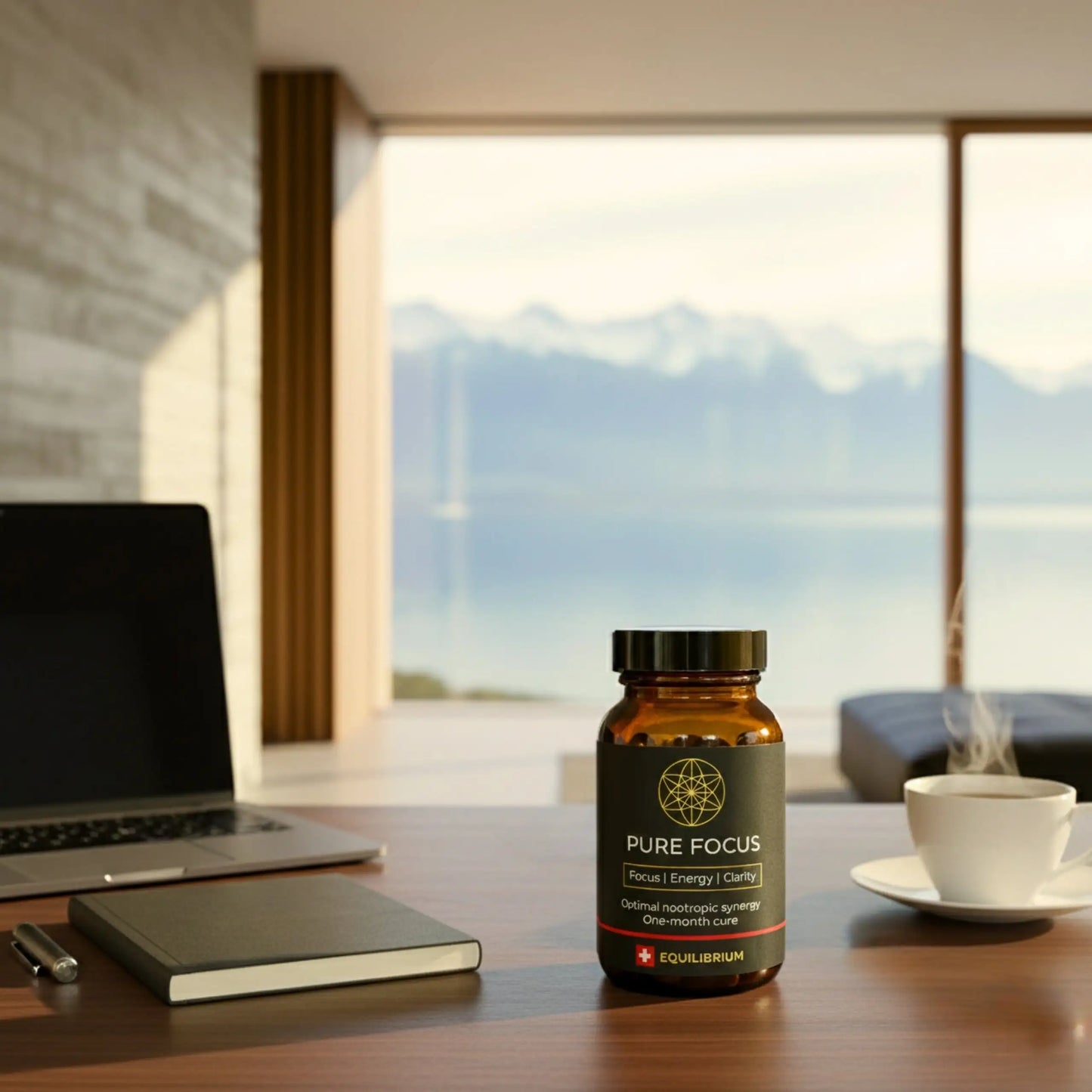
Our Pure Focus formula combines nine ingredients with their doses on the label: Lion's Mane (1,000 mg), citicoline (250 mg), bacopa monnieri (200 mg), L-theanine (200 mg), rhodiola rosea (180 mg), ginkgo biloba (120 mg) and vitamins B6, B9 and B12. Vitamins B6, B9 and B12 contribute to normal psychological function and to the reduction of tiredness and fatigue. The formula is made in Switzerland, vegan and caffeine-free.
Prefer a single ingredient? Our organic Lion's Mane and our creatine monohydrate are also available separately.
Frequently asked questions about nootropics
What is the most powerful nootropic?
There is no serious answer to this question. The substances with the strongest effects are medicines, with side effects and a prescription. Among supplements, the best-studied ingredients are creatine, bacopa and citicoline, with modest and gradual effects.
Can you buy nootropics without a prescription in Switzerland?
Yes for food supplements (Lion's Mane, bacopa, L-theanine, creatine, B vitamins). No for medicines such as piracetam, modafinil or methylphenidate.
How long before you notice an effect?
It depends on the ingredient. L-theanine combined with caffeine acts within about an hour. Bacopa, citicoline and Lion's Mane were studied over 4 to 16 weeks of regular use.
Do nootropics help with ADHD?
No food supplement is a treatment for ADHD. If you have significant attention difficulties, see a doctor, who can make a diagnosis and suggest appropriate support.
Can you take nootropics every day?
Most natural nootropics were studied with daily use over several weeks. Follow the dose on the label and ask for advice if you take medication.
Sources
- Kongkeaw C. et al. (2014). Meta-analysis of randomized controlled trials on cognitive effects of Bacopa monnieri extract. Journal of Ethnopharmacology, 151(1), 528-535. PubMed
- Nakazaki E. et al. (2021). Citicoline and Memory Function in Healthy Older Adults: A Randomized, Double-Blind, Placebo-Controlled Clinical Trial. The Journal of Nutrition, 151(8), 2153-2160. PMC
- Haskell C.F. et al. (2008). The effects of L-theanine, caffeine and their combination on cognition and mood. Biological Psychology, 77(2), 113-122. PubMed
- Prokopidis K. et al. (2023). Effects of creatine supplementation on memory in healthy individuals: a systematic review and meta-analysis of randomized controlled trials. Nutrition Reviews, 81(4), 416-427. PMC
- Mori K. et al. (2009). Improving effects of the mushroom Yamabushitake (Hericium erinaceus) on mild cognitive impairment. Phytotherapy Research, 23(3), 367-372. PubMed
Article updated on 10 October 2026 by the Swiss Equilibrium team. This article reports on the state of research and does not replace advice from a doctor or pharmacist. Food supplements should not replace a varied and balanced diet.