Creatine for Women Over 40 and 50: Menopause and Myths
Creatine for women over 40 or 50: relevance around menopause, what is demonstrated, common myths, dose and precautions. A clear guide for Switzerland.
Updated 22 November 2026 · 5 min read

In short: creatine is not reserved for men or bodybuilders. Women have, on average, lower creatine stores, and interest in creatine grows with age, when muscle mass and strength decline, especially after menopause. Research is also studying its combination with resistance training in older adults, with no authorised claim in Switzerland to date. It does not make you gain fat (the 1 to 2 kg at the start is water in the muscles) and it is not dangerous in a healthy woman at usual doses. The usual dose is 3 to 5 g per day of creatine monohydrate.
Why creatine interests women over 40
From age 40, we gradually lose muscle mass and strength. In women, this loss accelerates around menopause, with the fall in oestrogen. Yet muscle strength matters a great deal for independence, balance and preventing falls later in life.
Creatine helps muscles produce energy during short, intense effort, such as resistance training. That is why research looks at its combination with training in women around and after menopause. A 2021 review (Smith-Ryan et al., Nutrients) takes stock of creatine at each stage of women’s lives.
What is demonstrated, and what is not yet
| Topic | Status |
|---|---|
| Performance in successive bursts of short-term, high-intensity exercise (3 g per day) | Demonstrated, authorised claim |
| Muscle strength with resistance training in older adults | Studied, no authorised claim in Switzerland |
| Bone density after menopause | Mixed results, under study |
| Memory and mental fatigue | Under research, no conclusion, no authorised claim |
| Mood | A few preliminary studies, no conclusion |
The key point: creatine supports training, it does not replace it. The only authorised claim in Switzerland concerns performance during short, intense exercise, at 3 g per day.
Creatine and menopause: what to know
- It does not replace treatment: creatine does not act on hot flushes or other hormonal symptoms.
- It fits most lifestyles: as a powder, in a glass of water or yoghurt, once a day.
- It combines well with resistance training, which is recommended anyway after menopause for muscles and bones.
- It can affect a blood test: creatinine may rise slightly. Tell your doctor you take creatine before a test.
If you also have difficulty concentrating or with memory during this period, read our article Brain fog: causes, menopause and what helps.
Common myths about creatine in women
“Creatine makes you gain weight”
False. It can add 1 to 2 kg at first, but this is water stored in muscles, not fat. It contains no significant calories.
“Creatine makes you bloated and gives a bodybuilder look”
False. Water is stored inside muscles, not under the skin. Muscle size depends on training and diet, not on creatine alone.
“Creatine damages the kidneys”
Not in a healthy person, according to the many studies available. If you have kidney disease, ask your doctor before taking it.
“Creatine makes you lose weight”
No, that is not true either. It has no direct effect on fat loss. It may help you train better, which matters for body composition.
How to take creatine as a woman
- Dose: 3 to 5 g per day, without a loading phase. It is the simplest and best-tolerated method.
- Timing: it does not matter; what counts is taking it every day, including non-training days.
- Form: pure creatine monohydrate, with no added sugars or flavourings.
- Duration: stores fill in 3 to 4 weeks. Then assess over several months of training.
- Precautions: ask your doctor for advice during pregnancy and breastfeeding, or if you have kidney disease.
For all the details on dose and timing, see When to take creatine and our complete guide to creatine.
Which creatine to choose?
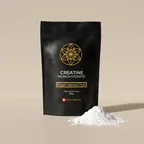
Our Creatine Monohydrate is 99.9% pure, micronised to dissolve easily, additive-free, vegan and made in Switzerland. One pouch covers 30 days at 3 g per day.
Article updated on 10 October 2026 by the Swiss Equilibrium team. This article is for information only and does not replace the advice of a doctor. Food supplements do not replace a varied, balanced diet.
Frequently asked questions
Can a 50-year-old woman take creatine?
Yes. It is a food that can be taken at any adult age, at the dose on the label; research is looking at its combination with resistance training after menopause, with no authorised claim on this point. Ask your doctor for advice if you have kidney disease or a specific treatment.
Is creatine dangerous for women?
No, in a healthy woman at usual doses (3 to 5 g per day). The most common side effects are a slight gain in water and, at high doses, digestive discomfort.
Do I need to do resistance training to take creatine?
It is not compulsory, but the only authorised claim concerns performance during short, intense exercise. Without that type of exercise, we promise no effect.
How long before I see an effect?
Muscle stores are full after 3 to 4 weeks at 3 to 5 g per day. We do not promise any timeframe for an effect.
- Smith-Ryan A.E. et al. (2021). Creatine Supplementation in Women's Health: A Lifespan Perspective. Nutrients, 13(3), 877. https://pmc.ncbi.nlm.nih.gov/articles/PMC7998865/
- Kreider R.B. et al. (2017). International Society of Sports Nutrition position stand: safety and efficacy of creatine supplementation in exercise, sport, and medicine. Journal of the International Society of Sports Nutrition, 14, 18. https://doi.org/10.1186/s12970-017-0173-z
- Antonio J. et al. (2021). Common questions and misconceptions about creatine supplementation: what does the scientific evidence really show? Journal of the International Society of Sports Nutrition, 18, 13. https://doi.org/10.1186/s12970-021-00412-w