Lion's Mane mushroom: the complete guide
Share
In short: Lion's Mane (Hericium erinaceus) is an edible white mushroom with long spines, eaten for centuries in Asia. It contains two families of molecules studied for their link with the nervous system: hericenones (in the fruiting body) and erinacines (mainly in the mycelium). A few small human trials have observed encouraging results on some cognitive tests and on mood. These studies remain limited: 30 to 50 participants, over 4 to 16 weeks. Lion's Mane was well tolerated in the studies, but data are lacking for pregnancy and breastfeeding. To choose a product, look mainly at the part of the mushroom used, the polysaccharide content, organic certification and quality testing.
What is Lion's Mane?
Lion's Mane is a mushroom of the Hericiaceae family. It grows on hardwood (oak, beech, walnut) in Asia, North America and Europe, including Switzerland, where it is rare in the wild. It is recognisable by its long white spines that look like a mane, hence its names: lion's mane, bearded tooth, Yamabushitake in Japan or Hou Tou Gu in China.
Not to be confused with the lion's mane jellyfish (Cyanea capillata), which has nothing to do with it.
It is eaten fresh (its texture is often compared to crab meat) or taken as a powder or extract in food supplements.
What do the studies say about Lion's Mane?
Research on Lion's Mane is active, but most of it has been done in the lab or on animals. Human trials can be counted on one hand. Here are the main ones, with their results and limits.
| Study | Participants | Duration | What was observed |
|---|---|---|---|
| Mori et al., 2009 (Phytotherapy Research) | 30 Japanese adults aged 50 to 80 with mild cognitive decline | 16 weeks | Higher cognitive test scores than the placebo group during intake. The gap narrowed 4 weeks after stopping. |
| Nagano et al., 2010 (Biomedical Research) | 30 women, including menopausal women | 4 weeks | Lower depression and anxiety scores than the placebo group, measured by questionnaire. |
| Saitsu et al., 2019 (Biomedical Research) | 31 healthy Japanese adults over 50 | 12 weeks | Improvement in some cognitive test scores compared with placebo. |
| Docherty et al., 2023 (Nutrients) | 41 healthy young adults | Single dose, then 28 days | Faster performance on an attention task after one dose. After 28 days, few significant differences, with a trend towards less perceived stress. |
Key takeaway: the results point in the same direction, but samples are small, the products tested differ from one study to another (powder, extract, enriched cookies) and doses are not comparable. Larger trials are needed to draw conclusions. Be wary of websites presenting Lion's Mane as a cure: no study supports that.
Hericenones and erinacines: fruiting body or mycelium?
Two parts of the mushroom are used in supplements:
- The fruiting body: the visible part of the mushroom, the one you cook. It contains hericenones and most of the polysaccharides (including beta-glucans).
- The mycelium: the network of filaments that grows in wood or, in industrial cultivation, on a grain substrate. It contains erinacines.
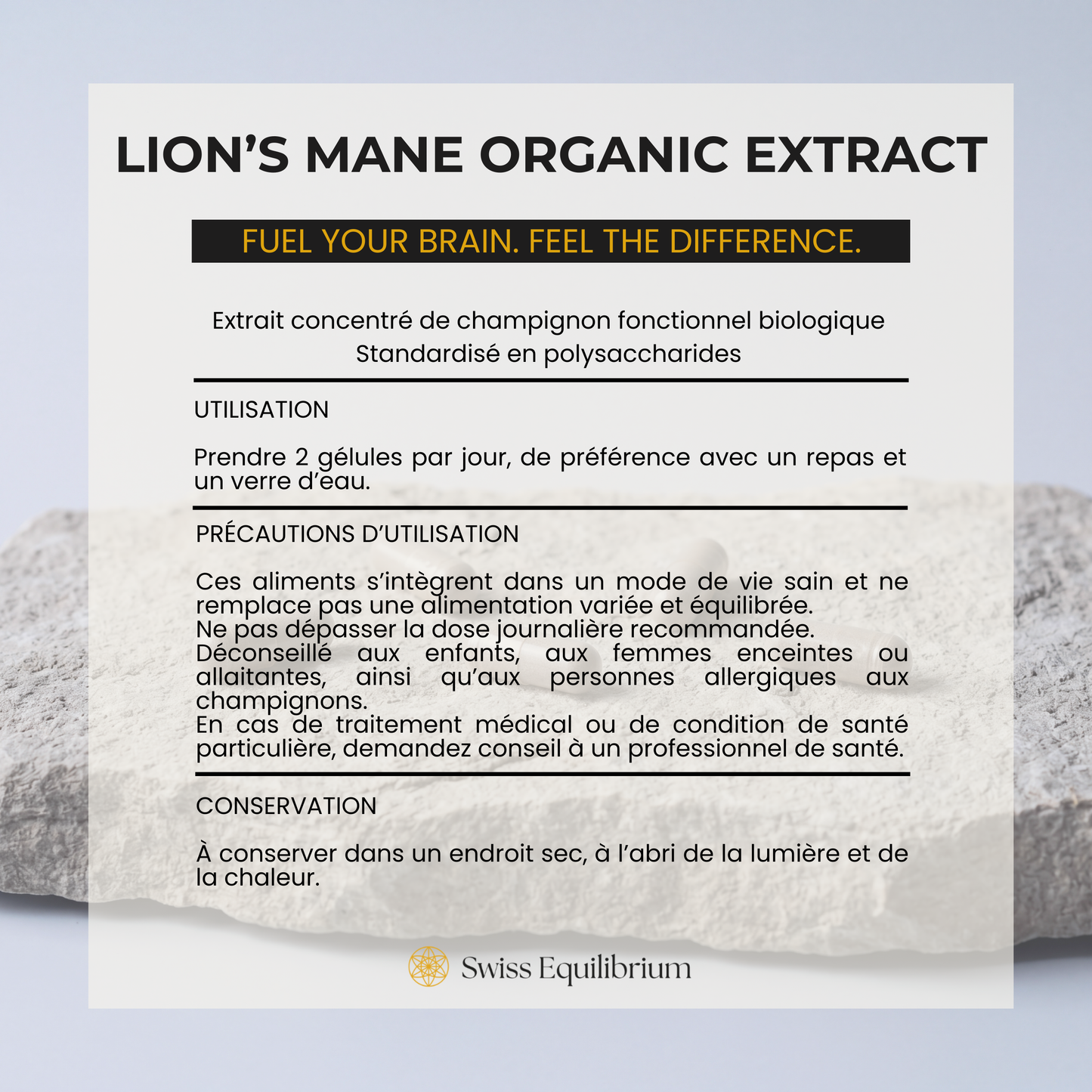
The catch: many "mycelium" products are grown on rice or oat grains, and the final product then contains a large share of grain starch rather than mushroom. A fruiting body extract standardised for polysaccharides avoids this problem. That is the choice we made for our organic Lion's Mane: 100% fruiting body, standardised to 30% polysaccharides.
How to choose a Lion's Mane extract
Six criteria to check on the label or product page:
- The part used: fruiting body, mycelium or both. If it is not stated, it is often mycelium on grain.
- Standardisation: a stated polysaccharide or beta-glucan content (for example 30%). Without a figure, you cannot compare.
- Extraction ratio: 1:10 or 1:15 means 10 or 15 kg of mushroom were used to make 1 kg of extract.
- Organic certification: mushrooms easily absorb whatever is in their substrate.
- Testing: analyses for heavy metals and contaminants, ideally available on request.
- Place of manufacture and transparency: identifiable brand, address, reachable customer service.
Dosage: how much Lion's Mane and when?
There is no official dose. In the studies above, amounts ranged from about 1 g to 3 g of mushroom powder per day. A concentrated extract is used at a lower dose than raw powder.
- Usual dose for an extract: 500 mg to 1,000 mg per day. Our Lion's Mane is taken as 2 capsules per day, about 1,000 mg.
- Timing: in the morning, with or without food. It is not a stimulant, so the time of day matters little.
- Duration: studies lasted 4 to 16 weeks. Think regular use over several weeks, not an instant effect.
Is Lion's Mane safe? Side effects and precautions
In clinical trials, Lion's Mane was well tolerated. Reported side effects are rare and mild: digestive discomfort, nausea, skin rashes in a few people.
As a precaution:
- avoid it if you have a known mushroom allergy;
- ask your doctor during pregnancy and breastfeeding, as data are lacking;
- talk to your doctor or pharmacist if you take medication, especially an anticoagulant or diabetes treatment;
- stop taking it if you notice an unusual reaction.
Where to buy Lion's Mane in Switzerland?
You can find it in pharmacies, drugstores, some organic shops and online. Prices vary widely, often because the products are not comparable: raw powder versus extract, mycelium versus fruiting body, organic or not. Apply the six criteria above before comparing prices.
Our Lion's Mane Organic Extract is made in Switzerland: organic fruiting body extract, standardised to 30% polysaccharides, tested for heavy metals, in plant-based capsules. Lion's Mane is also part of Pure Focus, our 9-in-1 formula (1,000 mg of Lion's Mane per daily dose). For an overview of other ingredients, read our guide to nootropics.
Frequently asked questions about Lion's Mane
How long before you notice an effect?
Studies measured results after 4 to 16 weeks of use. Allow several weeks of regular intake before judging.
Can you take Lion's Mane every day?
Yes, that is how it was used in the studies, for up to 16 weeks. Beyond that, data are scarcer.
Can you take Lion's Mane with coffee?
Yes, no interaction is known. Many people take it in the morning with their coffee.
What is the difference between powder and extract?
Powder is the dried, ground mushroom. An extract concentrates certain molecules (notably polysaccharides) through hot water extraction, sometimes combined with alcohol. A standardised extract tells you what you are taking.
Is Lion's Mane allowed in Switzerland?
Yes. Lion's Mane is sold in Switzerland as a food and food supplement.
Can you combine Lion's Mane and creatine?
Yes, nothing prevents it. See our creatine guide for more on creatine.
Sources
- Mori K. et al. (2009). Improving effects of the mushroom Yamabushitake (Hericium erinaceus) on mild cognitive impairment: a double-blind placebo-controlled clinical trial. Phytotherapy Research, 23(3), 367-372. PubMed
- Nagano M. et al. (2010). Reduction of depression and anxiety by 4 weeks Hericium erinaceus intake. Biomedical Research, 31(4), 231-237. J-STAGE
- Saitsu Y. et al. (2019). Improvement of cognitive functions by oral intake of Hericium erinaceus. Biomedical Research, 40(4), 125-131. J-STAGE
- Docherty S. et al. (2023). The Acute and Chronic Effects of Lion's Mane Mushroom Supplementation on Cognitive Function, Stress and Mood in Young Adults. Nutrients, 15(22), 4842. PMC
Updated on 10 October 2026 by the Swiss Equilibrium team. This article reports on the state of research. It does not replace advice from a doctor or pharmacist. Food supplements should not replace a varied and balanced diet.